
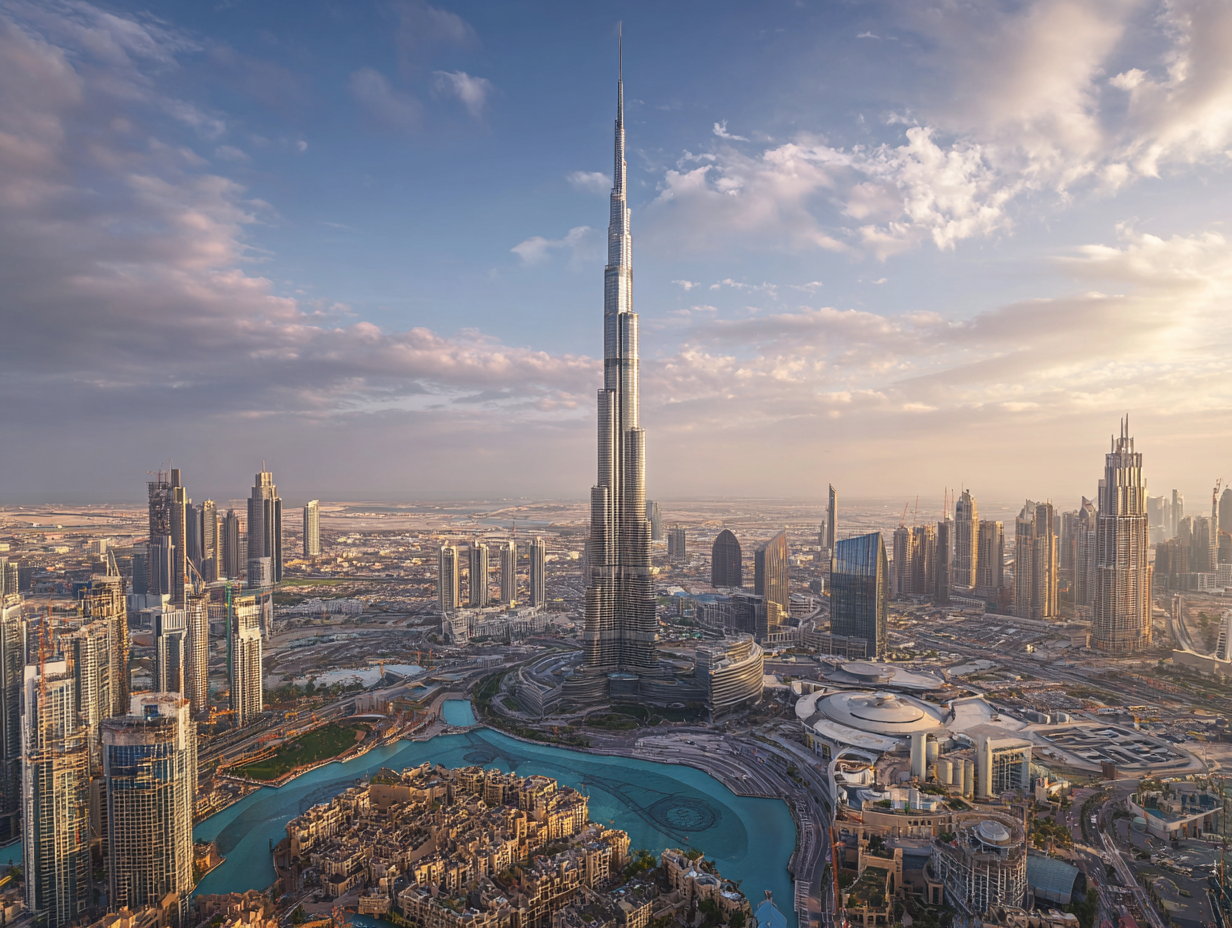
For Dubai, real estate has always been the most critical sector and a strategic pillar of the economy. But over the last few years, as sales and volumes have risen, the population has increased, and the global investor base has broadened, the property market has transformed itself into a sandbox for technological innovation and new investment models.
This notion is reinforced by the recently launched PropTech 2033 Whitepaper, published by the Dubai PropTech Hub, which is a part of the Dubai Financial International Centre (DIFC) and Dubai Land Department (DLD). As per the Whitepaper, Dubai’s prop-tech sector could generate more than AED 53 billion annually for the economy and address critical challenges in sustainability, data transparency, rapid build-outs, and urban living.
According to Sandeep Jadwani, Head of Investment Advisory, H Capital Limited, “PropTech is one of the most direct applications of new-age tech to a real-world problem in Dubai”. Jadwani noted that PropTech operates at the intersection of regulatory vision through strategies such as the Dubai Economic Agenda (D33), Dubai Real Estate Sector Strategy 2033, and Dubai 2040 Urban Master Plan, promising solutions and increasing investible capital.
A natural evolution for a digital city
According to Rakesh Mavath, Co-founder at Takeem, “PropTech in Dubai covers everything from property marketplaces and investment platforms to construction analytics, CRM software, and now AI-driven valuation tools and blockchain-based ownership models (tokenised assets).” His start-up, Takeem, itself, tries to solve a critical problem in Dubai’s big rental market: that of building trust between landlords and tenants, simplifying and monetising rent agreements, and providing a rental guarantee.
The first wave of prop-tech in Dubai focused on digitising property listings and marketing. These platforms, such as Bayut, Dubbizle, and Property Finder, aggregated listings, provided market analytics, and connected buyers with brokers. Today, these tools are evolving into fully digital ecosystems that include virtual tours, automated lead generation, smart search algorithms, and financing solutions.
According to Patrick Caulfield, CEO at Propspace, “AI (artificial intelligence) is increasingly being used to predict property prices, analyse buyer behaviour, and identify investment opportunities.” His company, Propspace, is a MENA-dedicated CRM platform that uses AI to process large volumes of real estate data, from transaction records, lead optimisation, and behavioural matching, to generate insights that would take weeks if done manually. The agentic use of AI for marketing and sales is also a growing area.
The third category of prop-tech solutions that have drawn global attention is fractional ownership and tokenisation. According to Adam Popat, CEO of SettleMint, “Dubai is an ideal ground for real-world asset (RWA) tokenisation in real estate. The Dubai Land Department (DLD) real estate tokenization experiment with Prypco Mint was the first of its kind, where blockchain technology was used to issue digital title deeds for fractional ownership. The project is now entering its second phase, in which tokens can be sold on secondary markets, increasing liquidity and transparency.”
If scaled properly, fractional ownership and tokenisation of RWAs could democratise the investor base and reduce risks of capital flight in Dubai’s real estate sector.
Prop-tech is also transforming how buildings are constructed and managed. Technologies such as IoT sensors, AI-driven energy management systems, and digital twins or virtual replicas of physical buildings are helping developers reduce costs and improve efficiency.
Government support and facilitation ecosystem
According to Mavath, “the innovation ecosystem in Dubai is very progressive at the access and regulation levels. The regulators have a high awareness of tech solutions and are willing to engage in new products.” Caulfield identifies three players in this eco-system: Dubai Land Department, prop-tech hubs and accelerators, and incubators and sandboxes.
Mavath noted that the first step for anyone wanting to enter the prop-tech space in Dubai should be the Dubai Land Department, the “tech-savvy” regulator. It has launched initiatives such as the Real Estate Evolution Space (REES) and works closely with regulators and start-ups to experiment with new models.
Dubai is also building a dedicated proptech innovation ecosystem through initiatives such as the Dubai PropTech Hub, created by the DIFC Innovation Hub and the Dubai Land Department. This institutional push is also being supported by regulatory experimentation. Under Sandbox Dubai, Dubai Future Foundation, and Dubai Land Department have partnered to help accelerate PropTech innovation and shape frameworks for real-world testing and deployment.
Accelerators and Incubators are also important pillars of this space. Mavath’s Takeem recently secured funding from REACH MENA, a prop-tech accelerator launched in Dubai to provide mentorship, market access, and investment opportunities for early-stage companies.
As per Caulfield, who has worked in global locations, he has not seen such a harmonised ecosystem as the DIFC Innovation Centre, which offers subsidised office space, networking events, and investor access. For Mavath, access to Dubai Silicon Oasis serves a similar purpose.
For Jadwani, the appeal of prop-tech firms is also starting to be appreciated by the Family Offices that he manages. He says that there are two rationales here: “First, a diversification from pure-play real estate, which is illiquid, to technology solutions like tokenisation, fractional ownership, etc., that can deliver returns while remaining in the space.”
“And second is investment in solutions that solve their operational issues, such as use of automation or AI to manage real estate portfolios, off-plan value discovery, and facility management,” Jadwani added.
The opportunities ahead
For Jadwani, with “the regulatory clarity and sandboxes” established by authorities such as VARA, talent being attracted by schemes such as Golden Visa, and a property market with a TAM of billions of dollars, prop-tech space will heat up.
Mavath and Caulfield highlight that the best way to take advantage of these opportunities is to create value through products, build local relationships, understand regional market dynamics, and have a clear entry strategy.
One of the most promising corridors of prop-tech innovation is India–Dubai. With Indians emerging as the top foreign buyers in Dubai’s property market, companies such as Magicbricks, Vertex Group, and Square Yards are offering cross-border discovery, investment, and property-management services using AI, digital tools, and fintech solutions.
Other regional markets are also on the agenda. As Caulfield says, the next step for Propspace is tapping other regional markets, echoing the ambition “to build in Dubai and scale to the region”.